
Talk · Dale Spoonemore
Growing food with Seed to Spoon — 2020 OKC Home & Garden Show
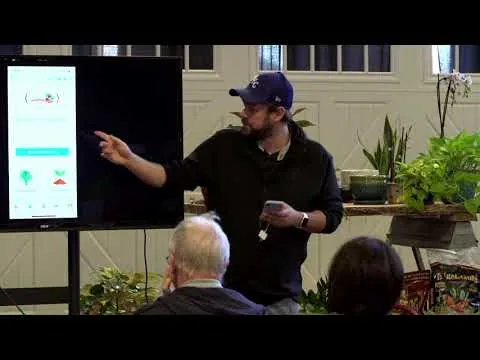
Edited excerpts from this talk. Follow the recording links to watch the full presentation.
Trying different things in a bed
In the recording: 10:33–11:02 · 11:14–11:27.
Square Foot Gardening is one of the first concepts that I learned about. There's a book called Square Foot Gardening that goes into detail about this, but it's really simple. The basic idea is this: you take your garden bed and you divide it into square feet. Every square can be planted independently of the square next to it and has its own numbers for how many per square it is. With spinach it's nine per square, which is nine seeds per square.
That's the basic idea behind Square Foot Gardening. It helps a number of things. First of all, it makes it easier. If you have a bed you can try all these different things. It doesn't feel as overwhelming.
Soil
In the recording: 3:30–4:02 · 5:04–5:40 · 6:25–6:45.
Once you've decided on what you want to grow in, if it's a smart pot, a container, it doesn't really matter at this point. The next step is soil, which is the most important part out of all of it. You can buy bagged soil mix from the store. I do recommend getting the soil mix that has the little white particles in it, vermiculite or perlite, because it really helps with moisture management. It's gonna get expensive though if you're buying soil mix from the store. We make it all ourselves.
It's really best to get compost from a variety of sources. Don't just go to one place and get compost. Try and get from a multitude of places. The reason for that is this: compost is the food for the plants. Compost from a vegetable source, compost from rabbits, compost from worms and all these different sources, and you mix them together. Now you've got a really well-balanced diet for your plants, if you will.
Those compost tumblers, they are great for making soil mix. You can spin it around and it mixes it for you. Mix it on a tarp, that works. It just takes a little bit longer. I really like those compost tumblers for that.
Sage pesto is my favorite
In the recording: 25:07–25:20 · 26:24–26:45 · 35:06–35:57.
Rosemary, sage, oregano, these kind of kitchen staples, those are often transplanted because it takes a long time to get them to a decent size. I'm typically buying those.
Sage pesto is my favorite. Just sage leaves. Quick pesto recipe: we have a guide on our website and videos, but it's really simple. You just take a bunch of leaves, like two handfuls, and then you do some pine nuts, some Parmesan cheese, some olive oil and some garlic. You can just mix it together in a blender, and that's all there is to it.
Basil is really easy to grow in Oklahoma here in the summer. We're starting most of our basil from seed, like 75% of it. We're just sprinkling seed everywhere, but I will go get a couple basil transplants early April when I plant my tomatoes. I'm not having to wait until May to get some basil. There's a lot of different varieties of basil as well. Our favorites are Thai basil. There's a lettuce leaf basil as well that makes a really big leaf that's really mild, so you can put it on a sandwich.
Anything that vines
In the recording: 31:18–31:38 · 31:57–32:23 · 32:44–33:20.
We love growing peas. They're really easy to grow. We pretty much only grow the vining varieties, and we'll plant it along some sort of fence. The cheapest way we found to make fences is to get cattle panels or the hardware remesh panels.
We also have the cattle panels. We also arch them over and put two next to each other. We'll grow several things on them. We'll grow beans on them. They grow all the way over and hang down.
We're also growing small watermelons that way. The bigger watermelons, you have to give them some support to keep them from snapping off, so we stick to the small watermelons. Anything that vines, we're trying to get it on a fence. You really maximize your space. If you train them to go up, now you're being more efficient with your space.
The way I grew broccoli
In the recording: 37:17–38:34.
Once I learned that the entire broccoli plant is edible, that changed the way I grew broccoli, and I started growing different varieties. That's pretty much all I grow now, these sprouting broccoli types, because you get so much more out of it. Broccoli is one of those one per square plants. The first year I did that, I planted one little broccoli plant in this square and had all this extra space around that plant that went wasted for six weeks until that broccoli plant took up that space.
What I do now is if I'm planting broccoli in a square I will sprinkle seeds in the entire square. I'll end up with maybe twelve plants growing in that square, and then I will just let the best one be the one that survives. I'll thin them down as they continue to grow.
When we harvest greens
In the recording: 49:03–49:42.
When we harvest greens, if it's lettuce we're cutting the entire plant just like an inch above the base, and then it will regrow sometimes three times. With spinach we're harvesting three leaves off each plant, and with kale we're doing the same. We're not pulling the entire plant up or anything like that because it'll continue to produce. A lot of these plants are called cut and come again, where you can cut it and it grows back again. Lettuce, spinach, they're all like that. Really the thing you're fighting with those plants is the heat. You're doing that as much as you can until it gets too hot.