
Talk · Dale Spoonemore
Getting Started on a Project — freeCodeCamp Oklahoma
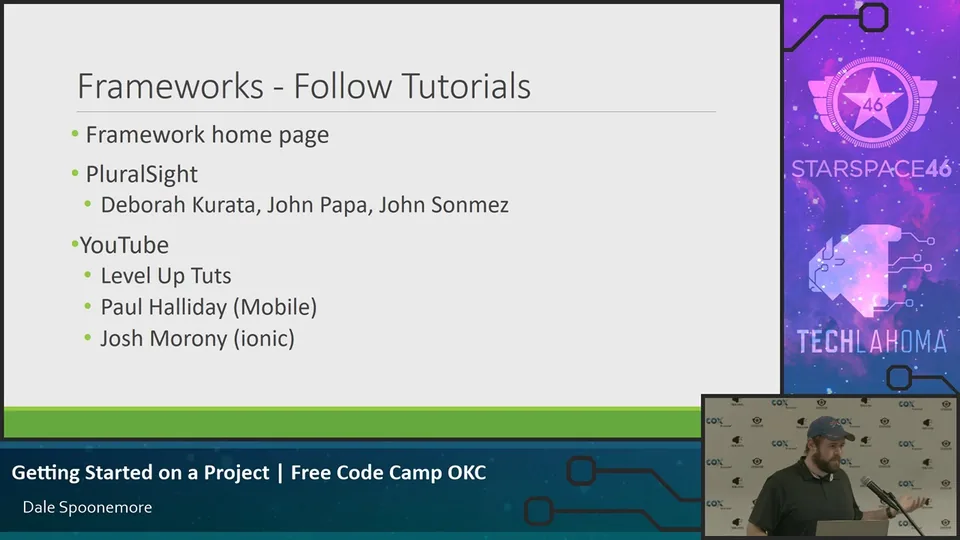
Edited excerpts from this talk. Follow the recording links to watch the full presentation.
Find something you're passionate about building
In the recording: 3:57–4:19 · 4:59–5:46.
You've got to find something. Whatever it is, it doesn't matter what it is. Find something you're passionate about building, something you're excited about building, because that will keep you focused on a goal. It's really easy to get overwhelmed if you're just doing example projects one after another. You'll end up with a pile of fifteen different example projects and no idea what you want to build or where to start. I was there for a long time.
With a mentor, they're gonna guide your learning path. There are so many different places you can go with development, so many different avenues you can go down. You can spend a lot of time obsessing over what do I learn. I've done that for a long time. I've learned a little bit about a lot. They're also gonna be there to answer your questions. If you run into a problem, it's really good to have someone that you can go to that you know is gonna have a solid answer for you. Also they're gonna review your code. I have them read my code all the time, and they're able to spot errors and help me fix mistakes before they pile up. I'm able to learn how to do things better as I go.
Ionic serve
In the recording: 23:33–24:03 · 24:11–24:33.
Typing ionic serve just kicks off the ionic server so that I can launch a browser window and I can see my app. I can pretty much see how my app would look. I can go through and I can click on it just like I would tap. I can use the app.
Invest in time and learning shortcuts because it saves you so much time. You can switch pages with control P and start typing and go between pages. There's all these different shortcuts you can use in Visual Studio code or whatever editor you are using. Take the time to learn them because it does make a big difference.
The power of the frameworks
In the recording: 26:28–28:05 · 28:41–29:31.
My app has a list. This is how I built it. I chose lists. I found what I wanted to build. I like the thumbnails better as they take up more space. I took code, copied and pasted it over, change the paths, and then that's literally all I had to do. I don't have to be some design expert or UI expert. I just have to know what looks good.
If you need a grid, it shows you the code for how to make different grids. If you need an alert to pop up, here's the code for how to do a basic alert. The power of the frameworks: it makes these things so easy. I can focus on the things that I want to build. What I started with was just taking some of the sample code, pasting it over into my project and then just changing things and learning how things work that way.
The really cool thing about ionic: to start a new project, ionic start I think is the command. It scaffolds out some dummy data and some placeholder data, with three tabs at the bottom. If you want a menu, it'll scaffold out a menu app. You generate these pages through the CLI. There's a command, ionic generate page and then the name of it, and it even adds it to the app module. The point is it does a lot of things for you.
Just get up and walk away
In the recording: 14:56–15:16 · 15:54–16:16.
If you get stuck on a problem and it's more than 30 minutes to an hour, just get up and walk away and go do something mindless. For me that's watering the yard, watering the plants, washing the dishes. Something that's just mindless, that's the whole point.
Don't get stuck. If you're on a problem, I give myself about an hour if I think I have a pretty good shot at it. If I'm clueless on it then about thirty minutes. But the point is don't get stuck. If you can't figure something out, try walking away.