
Talk · Dale Spoonemore
Code the Change — ThunderPlains 2018
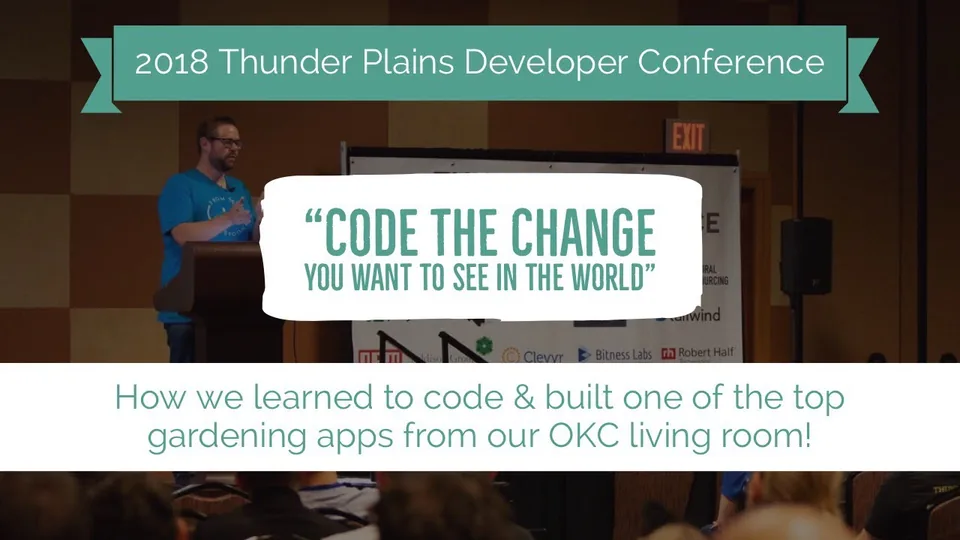
Edited excerpts from this talk. Follow the recording links to watch the full presentation.
We started building user stories
In the recording: 7:50–8:42.
We started building user stories. This was really where the development of the mobile app started. It was just an Evernote or Trello or something back then, started building what we knew the app would need to be. But we still didn't really know what the app should be then. We knew what problems we had with gardening, but we didn't know if there was the same problems other people had, and the problems that we could solve for other people. That's when we started doing events. It started with kids events, and we would go to local nurseries and we would put on kid's gardening festivals. We made them completely free, and any kid could come out and they get to bring home a seed that they got to plant themselves. We had all sorts of different things that kids got to do, but it also got us an opportunity to talk: what would it take for you to start growing food? Why don't you grow food now? Questions like that. All of that is what led into the ideas for the apps.
Trying to figure how they work
In the recording: 10:41–10:48 · 11:09–12:01.
I started obsessively reading everything I could about Ionic and downloading sample apps and tearing them apart and trying to figure how they work.
I started binging videos. I would go through it until the point where it didn't make sense to me anymore, and then I would start over at the beginning and just work my way back up again until I got to that point was confusing before. Now suddenly that part was easy, and I just kept going through that cycle over the course of three months.
That's what I did with all that time that before was going to playing video games and watching every TV show that everyone talked about. That's all I did with that time before, and not that there's anything wrong with that time. I think there's a time and a place to do stuff like that, but for me, where I was in my life, I felt like I shouldn't be obsessing over video games anymore. That time needed to go to something else, and that's where I started pulling from to learn this stuff. It was a lot of nights and weekends.
See what people care about
In the recording: 14:24–14:43 · 15:15–16:09.
Version 1 was just get all this data out and see what people care about. We didn't spend a lot of time on the UI making it perfect. We just got things out, and then we transitioned into finding out if this worked, if people liked this, if this is what people needed.
I reached out to every home and garden show I could find, and luckily those people are awesome, and they invited us to come speak. We got in at the two largest home and garden shows within my city. For those weekends I took our RV to the State Fairgrounds, and I parked it on Friday and I spent the entire weekend there. I just talked to people, thousands of people, the whole weekend. Through that we learned a lot. When you're showing someone your app and you're showing it in front of them, it becomes pretty easy to start reading their eyes, and you can see what they're confused about. Or when you're explaining something, you see something that doesn't quite make sense. Our marketing message evolved like tenfold that one weekend of just trying things over and over. Through each interaction that we had where we could see that something didn't quite make sense, it taught us what we can go back on the UI to improve.
The app store reviews
In the recording: 16:11–16:56 · 17:07–17:34.
I want to mention here the app store reviews because this is how we really started to gain traction. I believe out of all the things that we did, the app store reviews probably drove our growth more than anything. The way that we got those was, one, provided good value for them, put out a good app. The strategy we have for reviews was prompting them at four, five opens. If we prompted them on the first open, they don't know if they liked us yet. It's annoying, right? But after five opens, now it comes up, and the text wasn't like, please leave a review, whatever. It was very candid: I don't like having to ask you for this, or something like that, but please leave a review, it helps us get traction. That was really what drove a lot of our growth.
I also want to talk about our approach to the App Store in general because I think a lot of apps take for granted release notes. I think release notes are a way that you can really make an impact with your user because people actually read that. Not everyone, but there are a lot of people that really read release notes, especially if they're looking at an app. There's an opportunity right there where you can actually talk to your users with your real voice and have an impact.
Know your weaknesses
In the recording: 19:49–20:19.
I want to mention this because I think it's important to know your weaknesses and to build a team around them. I really like building front-end stuff and user interactions. That's where I like to spend my time. Knowing your weaknesses and building around them is crucial if you want to start building a team, because especially with the startup you don't have very many people you can bring in. You've got to make sure the people you do bring in compliment things you're not strong in.
It's a marathon and not a sprint
In the recording: 32:16–33:41.
It's a marathon and not a sprint. This is something I've made mistakes on time and time again. I forget this is a long term thing. You can't sprint towards your goal. You're going to get gassed out. I think automation is something that we did not do enough of in the beginning, but it's been crucial to sustainability of this.
What I mean by that specifically is with social media. If you are on the hook for manually posting to Instagram four times a day and Twitter four times a day and Facebook twice, and having a Facebook group that you also post into, and then sharing your posts into like 30 other gardening groups, if you're manually doing that, it make you go insane. I promise it will. There's so many tools out there that help with this. Tailwind was here today, their tool is awesome for Pinterest automation. I use Buffer for Instagram and Facebook and all of that. Spend the money on those tools because it is well worth it, and it saved us so much time and frustration.
Delegation is not something I'm good at, and I had to really learn how to say, I need help with this, or have someone take something over. If you're going to do a start-up or try and do something on your own, you have to rely on other people around you. You can't do it on your own. Lastly, remember your why. You've got to remember why you're doing it because if it becomes about money your passion will die, at least that's how it was for me. It can't be about money. It's got to be about why you're doing this, and that has to be what you bring yourself back to.